How a Decluttering Session Works: Keep, Donate, Let Go
A plain walk through the three-answer sort that sits at the center of every decluttering session.
September 30, 2026 · 4 min read
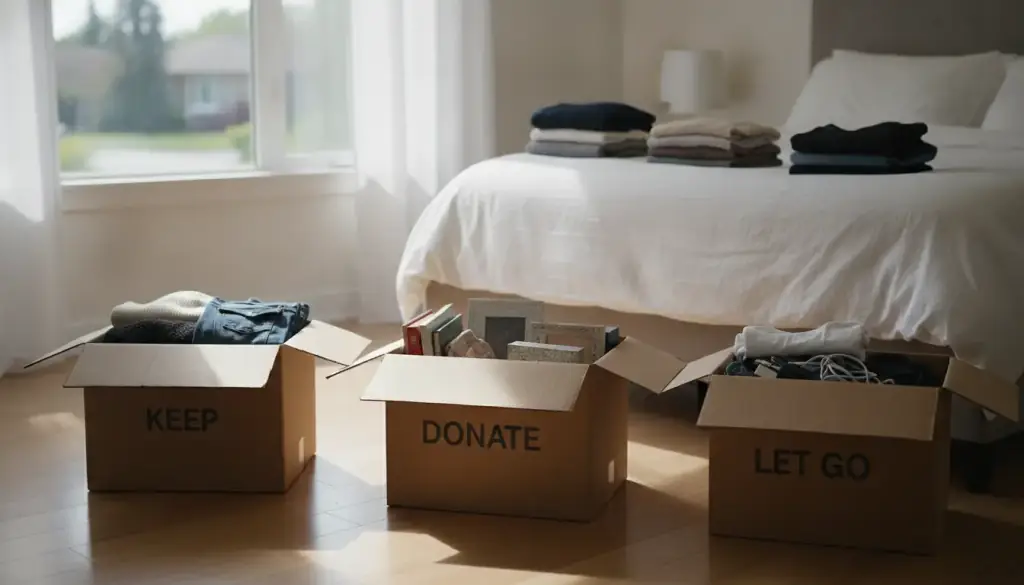
Most people picture decluttering as one giant pile and a long weekend of guilt. A session with a professional organizer is calmer than that, and it follows a pattern you can learn. Every item gets one of three answers: keep, donate, or let go. Here's how that plays out room by room, so you know what to expect if you book with Orderly Abode in Lake in the Hills, or so you can try it on your own first.
Start with the space and the goal
Before anything moves, you look at the room together. At Orderly Abode, a session begins by assessing the space and talking through what you want from it. That conversation matters more than the sorting. A bedroom you want to feel restful needs different decisions than a bedroom that doubles as a home office.
Say your goal out loud in one sentence. 'I want to find my clothes in under a minute.' 'I need the spare room back for guests.' A goal gives you a tiebreaker when an item is hard to judge. If it doesn't help the goal, it's a candidate for donate or let go.
The three piles, defined
Keep, donate and let go sound obvious. The trouble is that people define them loosely, so items drift from one pile to another at midnight. Use these definitions instead.
- Keep: you've used it in the past year, it has a clear job in your home, or it matters to you for a reason you can name out loud.
- Donate: it's in good shape and someone else could use it today, but you won't.
- Let go: it's broken, stained, expired, missing pieces, or one of so many duplicates that nobody needs the extra.
- Maybe: one small box with a size limit, for the few items you truly can't call yet.
The maybe box needs a hard edge. Give it one box, write a date on the lid, and decide now what happens when that date arrives. If you haven't opened it by then, the answer is already clear.
Work one category at a time inside one room
Sorting one room at a time keeps the job finite. Finishing a room gives you a visible win, and that win carries you into the next one. Inside the room, sort by category instead of by drawer. Pull all the clothes out before you judge any of them. Take every mug out of the cabinet and set them on the counter. Ten mugs side by side make the decision easy in a way that one mug in a cupboard never does.
Start with the easy items. Trash, expired products and obvious duplicates build momentum. Save sentimental things for last, because you'll decide them better once you're in a rhythm. Skipping them early isn't avoiding them. It's putting them where you have the most energy to give them a fair look.
What to have ready
Good prep keeps the decisions moving and keeps the room from filling up with half-sorted stuff.
- Boxes or bags for each pile, labeled so nothing lands in the wrong one.
- A trash bag and a recycling bag within arm's reach.
- A clear surface, like a bed or a folding table, where you can lay items out together.
- The address of a donation drop-off near you, so donate items leave the house quickly.
- A short note of what you want the finished room to do.
Pick the drop-off before you start. A bag of donations that sits by the front door for weeks tends to slide back into the house. A Fox River Valley winter doesn't help, since nobody wants to load the car in the snow. Keeping the bags in the garage or trunk until the drop-off run takes that excuse away.
Making the hard calls
Some items won't sort themselves, so ask a few plain questions. Would I buy this again today? Does it fit my life as it is now, not as it was or might be? If I needed it next month, could I borrow or replace it without much trouble? A yes to the last one often settles the matter.
Gifts and keepsakes are harder. The object is not the person, and it is not the memory. You can keep the memory and let the item go. Or you can keep the best few pieces, photograph the rest, and send them on. Having someone with you helps here. One Orderly Abode client, Jennifer I., wrote on Thumbtack that the team "definitely made me feel less anxious about everything that needs to get done." A calm second person in the room makes slow decisions feel lighter.
Close the loop before you stop
End every session by moving things out. Donation bags go to the car. Trash goes to the bin. What you kept goes back with a home, not onto a new pile. That last part is the piece most people skip, and it's why rooms refill. Orderly Abode leaves clients with tips and systems to stay organized, because a room stays tidy when every kept item has a spot it belongs in.
If you'd like help with a decluttering session in Lake in the Hills, McHenry County, Kane County or DuPage County, call Orderly Abode at (224) 609-7393 or email stacie@orderly-abode.com to set up a free consultation. A single closet or a whole house is fair game.
Orderly Abode, (224) 609-7393
Call (224) 609-7393More articles
Pantry Organizing That Survives the Next Grocery Run
A pantry only works if it still works on the day after a big shop, so build it around that day.
Get Your Home Ready for a Move Before the Boxes Come Out
The best time to lighten a move is before a single box is taped shut.