Design Your Closet Around How You Actually Get Dressed
The best closet layout starts with watching yourself get dressed, not with a catalog of shelves.
September 30, 2026 · 4 min read
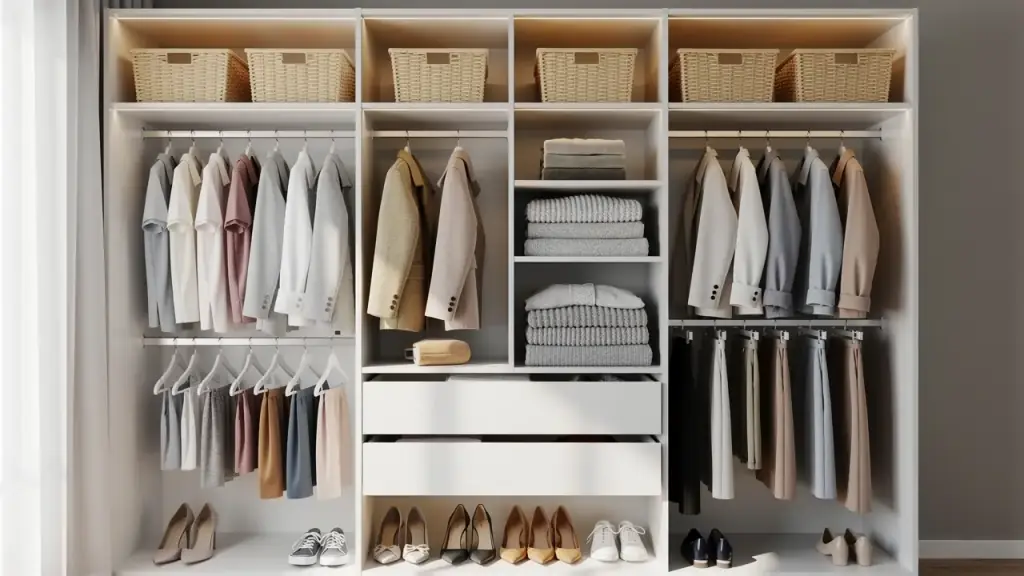
A closet should make getting dressed easier. Too often it does the opposite, because it was built to a standard pattern: one long rod, one shelf above it, a pile on the floor. Your clothes and habits aren't standard. Designing around them is how you end up with a closet that works on a busy morning, and it starts well before you buy a single rod or bin.
Watch your own routine for a week
For a week, notice how you really dress. What do you reach for first? Which items do you wear constantly, and which sit untouched? Do you pick an outfit the night before, or grab the first clean thing? Write down what you see. Those notes matter more than any layout you found online.
Then edit. Take everything out, sort it into keep, donate and let go, and be straight with yourself about what you wear. You're designing for the wardrobe you use, not the one you hope to fit into someday. The smaller and more honest the keep pile, the less closet you need to design.
Decide what hangs and what folds
Hanging and folding each have a place, and the split depends on the clothes. Shirts, dresses, pants with a crease and anything that wrinkles tend to do best on hangers. Knits stretch on hangers, so fold them. T-shirts, jeans, sweatshirts and workout clothes fold neatly and stack well.
- Count your hanging items by length: short (shirts, folded pants), medium (skirts, jackets) and long (dresses, coats).
- Group same-length items on the same rod so the space below them is usable.
- Use double hanging, two rods stacked, for short items, which can nearly double the capacity of that section.
- Put folded items on shelves or in drawers no deeper than a stack you can see from the top.
- Use matching hangers. It looks minor, and it saves real room.
Leave a long section for dresses and coats only if you own enough of them. A single tall run for a handful of long items wastes a lot of wall.
Give shoes a real system
Shoes look small, but they take over a closet floor quickly. Decide how many pairs belong in the closet and how many belong elsewhere, like boots in the entry closet through winter. Fox River Valley winters mean a good share of your footwear is seasonal, and storing the off-season pairs in boxes up high frees the floor for what you wear now.
For everyday pairs, use slanted shelves or a low tiered rack so each pair is visible without moving another. Line heels and dress shoes along a shelf at a height where you can see the toe. Keep sneakers near the door of the closet, since they leave the house most often.
Put the top shelf to honest work
The top shelf is the most wasted space in most closets. It's hard to reach, so things go up there and stay forgotten. Use it only for what you touch a few times a year: off-season folded sweaters, extra bedding, luggage, keepsake boxes.
Use uniform bins with labels on the front so you can find things without pulling down every one. Keep a small step stool inside the closet, not in the garage, so getting to the shelf doesn't take a hunt. If you can't reach a shelf without climbing on the furniture, the shelf is too high for daily use.
Find a home for accessories
Belts, scarves, ties, bags, hats and jewelry are the things that end up on the dresser, the doorknob, or the floor. Each one needs an assigned spot. Shallow drawers with dividers work well for jewelry and watches. A row of hooks or a hanging rail handles belts and scarves. Bags stand up best on a shelf with a divider or in a row at eye level.
Put the accessories you use daily at the front, in the spot you reach first. The rest can live further back. A mirror on the inside of the door and good light over the whole space turn the closet into a place to get ready, with storage as a bonus.
Reach-in or walk-in, the method is the same
A small reach-in closet has less room to be forgiving, so it rewards careful planning. A walk-in gives you space but also more room to waste. In both, the steps are the same: edit, measure, sort by how you dress, and assign every category a zone. Orderly Abode works on closets of every size, from a single closet to a whole home, and offers both design solutions and custom closet installation.
If you'd like a closet planned around your own routine, call Orderly Abode at (224) 609-7393 or email stacie@orderly-abode.com to schedule a free consultation. We serve Lake in the Hills and McHenry, Kane and DuPage Counties.
Orderly Abode, (224) 609-7393
Call (224) 609-7393More articles
How a Decluttering Session Works: Keep, Donate, Let Go
A plain walk through the three-answer sort that sits at the center of every decluttering session.
Pantry Organizing That Survives the Next Grocery Run
A pantry only works if it still works on the day after a big shop, so build it around that day.